⋆⁺₊⋆ ☀︎ ⋆⁺₊⋆
Pachycephalosaurus
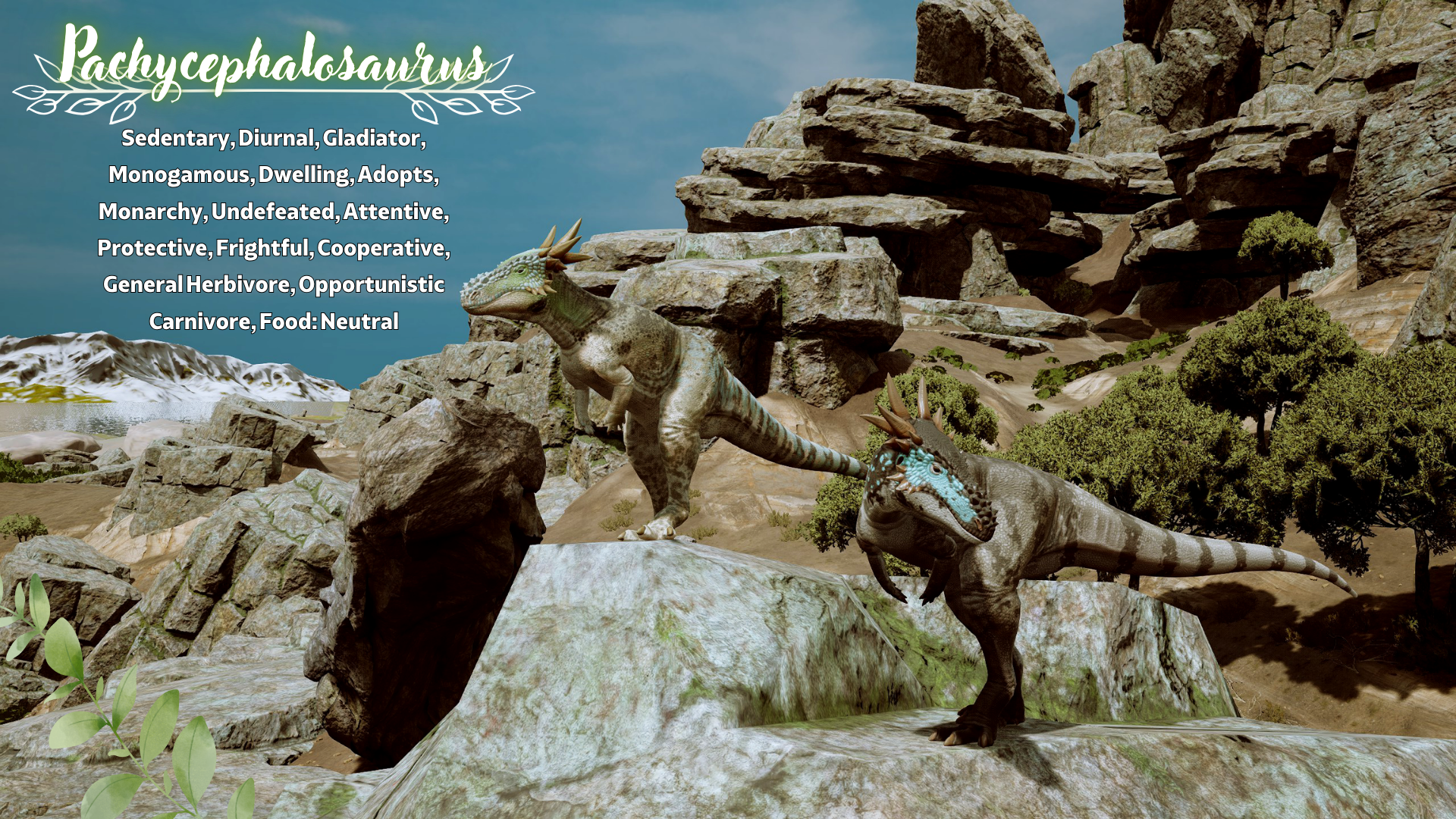
-
Highlights:
- Complex interlocking groups within a herd bring purpose to each Pachycephalosaurus.
- They are experts at traversing difficult terrain and live along steep cliffsides.
⋆⁺₊⋆ ☀︎ ⋆⁺₊⋆
Group Limits
- Court
- Up to 30 Pachycephalosaurus of any age and gender.
- Must contain at least one member of a high lineage to count as court.
- Flock
- Up to 6 Pachycephalosaurus of any age and gender.
- Does not contain a courted pair of the high lineage.
- A flock is nomadic and will not nest, as they don’t have the security of a structured court for that.
- Pachycephalosaurus can group with solo Lambeosaurus. They don’t count to the group limit and won’t be defended.
Nest Limits
- Blooming Season: 3 eggs, 2-hour Interval
- Scorching Season: 2 eggs, 2-hour Interval
- Wilting Season: 2 eggs, 2-hour Interval
- Frosting Season: 1 egg, 3-hour Interval
Sexual Dimorphism
- Sexual Dimorphism does only play a role in courting.
- Males are known as Rams.
- Rams greet other Pachycephalosaurus by shaking their body.
- Females are knowns as Ewes.
- Ewes greet other Pachycephalosaurus by friendly-calling.
- Mutations
- Albinistic and melanistic Pachys only face side effects when born into the high lineage.
- Since they cannot display their belonging with the high lineage colours on their skin, they end up not being treated as a monarch.
- Blindness
- Blindness is visualised by green or blue eyes. To avoid blindness, players must choose any colour that is not green or blue. Blindness is usually caused by heavy concussions during fights.
Lineages Dimorphism
- High Lineage
- Members of the high lineage contain blue, purple or pink in their skin.
- Rams more often contain blue than purple or pink, while ewes more often contain pink or purple than blue, though this is not mandatory.
- Other lineages do not carry these colours.
- This colour dimorphism is mandatory.
- Protector Lineage
- Protectors are usually very dark in colour and have black in at least 50% of their skin. Families in this lineage often carry the spinifer or wyomingensis subspecies gene in them.
- This dimorphism is optional, but encouraged.
- Nurse Lineage
- Nurses have earthy tones in their skin. Their colours can turn out very bright and colourful, containing shades of red and yellow.
- This dimorphism is optional, but encouraged.
- Forager Lineage
- Foragers have green shades and blend in well with the shrubbery.
- This dimorphism is optional, but encouraged.
- Not following dimorphism may cause confusion within the court, as they will be unsure which lineage you belong to.
Habitat
- Sedentary
- Pachycephalosaurus are mostly sedentary and stay in one POI for as long as the high lineage sees fit. They tend to change their home POI and migrate to another POI should any of the following happen:
- They have completed 5-10 nesting cycles.
- The high lineage senses that the ground is no longer sufficient.
- They are driven out by predators.
- They lose a challenge to another species of any kind.
- They are naturally skilled climbers and therefore love to stay in the most mountainous and often impassible terrain they can find. Preferred are cliffsides with enough shrubbery to be able to hide from aerial predators. In these places they have an advantage over other, less sure-footed predators and additionally have the best overview of their surrounding area.
- Pachycephalosaurus are mostly sedentary and stay in one POI for as long as the high lineage sees fit. They tend to change their home POI and migrate to another POI should any of the following happen:
- Prefers: Mountains, Dense Woodlands, Mesa
- Dislikes: Marshlands, Beaches, Valleys
Activity
- Diurnal
- During the day, Pachycephalosaurus roam their biome and go about their business.
- At night, most of the Pachycephalosaurus sleep, though some of the protectors continue to keep watch and nurses tend to offspring or injured court members.
Diet
- General Herbivore: Neutral, Opportunistic Carnivore
- Pachycephalosaurus adjust their diet depending on what the biome they inhabit offers the most. Usually, the court claims one or more bushes close to their nesting site, but if none are available, they will instead fall back on noxious meat, fish, carrion, and bones.
- Able to eat berries, fruit, carrion, fish, noxious meat, and bones.
⋆⁺₊⋆ ☀︎ ⋆⁺₊⋆
Growing Behaviours
Hatchling
Pachycephalosaurus offspring, called lamb, hatch in the protected midst of their court, surrounded by their parents and nurses. In their first phase of life, lambs are eager to get on their feet and discover their nesting grounds. Therefore they are somewhat resentful when they are ushered back to their nests by the nurses, as they want to prevent the offspring from falling down anywhere in their rugged nesting grounds. While Pachycephalosaurus hatchlings are quick on their feet, they lack the experience and preciseness of adult Pachys to navigate the rough terrain safely.Instead they play within a small zone around the nest which the nurses and parents declare safe to stay in. The hatchlings form their first friendships with others of the same age and strengthen their bond to their parents.
Monarch lambs are sometimes kept a bit offside from others by their parents until they reach juvenile, as the parents are especially worried about them being hurt in any way.
Juvenile
Juvenile lambs leave the nests and expand their exploration past the safe zone together with either parents or nurses. In this important stage of their upbringing, all offspring are taught by the nurses how to traverse the terrain they are born in, reach high grounds, jump over gorges and quickly cover distances.Adolescent
As the lambs grow older, they will start to leave the nesting area and become more invested in what their parents spend their time with. The nature of their inherited lineage will start to show as they observe their parents and other members of their lineage with interest, accompanying them at their tasks and trying their best to help.Sub/Adult
Subadults will take on lineage tasks by themselves now and are seen as a fully-fledged member of the court.Orphan Behaviours
- While orphans are quick to get up and seek shelter in shrubbery, they have a disadvantage when they reach their juvenile stage.
- Contrary to their nested in peers, if they don’t find any nurses to teach them proper mobility skills, they may turn out to be less skilled in traversing difficult terrain.
- Additionally in adolescence they will miss out on learning about their lineage's tasks and will only have some fundamental behaviour of their inherited lineage in them by nature. Once they find a court to join later on, they often try to find their place by watching different lineages until they find out where they belong. They are eager to integrate themselves and will not have any drawbacks after the integration phase.
- Orphans may be adopted by both flocks and courts, though in courts they have nurses to take them in and teach them elementary skills, while they don’t have any particular caretakers in flocks.
Lineages
- Pachycephalosaurus courts are made up of subgroups called lineages. These lineages have their own responsibilities within the court and are usually attributable by their skin colour. In some cases, lineages are hereditary and cause a family to be formed within a lineage.
- High Lineage
- The high lineage is the monarch family of a court.
- This lineage consists of the directly related monarchs and their consorts.
- It’s usually the oldest pair of the high lineage that leads the court.
- They have priority for food when the resources are scarce, decide over migration destinations, approve of courtships, get to pick their nesting spots first and have guards - usually the closest and most trusted members of the protector lineage - to protect them.
- Since they have guards to protect them, the monarchs very rarely have to fight.
- Protector Lineage
- The protector lineage are Pachycephalosaurus that have specialised in looking out for, warning of and defending against threats.
- Usually, two members of this lineage function as guards for the monarchs at all times. They will follow them around and make sure that they are respected and safe.
- When there are no imminent threats, the rest spend their day taking turns on lookout posts to watch out for danger, resting and playfighting - often spectated by monarchs for assessment and entertainment - to keep their muscles strong and reactions sharp.
- They defend food resources from any species if called over by a forager.
- Nurse Lineage
- These Pachys dedicate their time to help raising offspring and tending to injured, disabled or elderly court members.
- They watch over offspring and raise them as one of their own - soothe them, tell them off and play with them. Their task is also to work together with foragers to fill the nests with food for the offspring to eat from.
- Nurses also take care of any members of the court that are too weak to care for themselves, be it elderly, injured or disabled Pachycephalosaurus. They will bring them food, guide them to water and keep an extra eye on them.
- Forager Lineage
- Foragers are responsible for administrating and collecting food, as well as transporting or handing it over to the nurses and serving as scouts during migrations. They are often the most knowledgeable about escape routes and general terrain mobility.
- Pachys of the forager lineage often bring food pieces over to the nurses to fill nests or to the high lineage members to make them gifts.
- If there are not enough resources, foresters may even fall back to hunting little critters for their noxious meat.
- When a claimed resource drops below 20%, foragers become snappy towards any other dinosaur that is not a nurse or any of the monarchs, as they want to reserve the remaining resources for the nurses to feed the offspring with and the monarchs to have access to food anytime they like. If the eating dinosaur doesn’t comply with the forager telling it off, they will broadcast to call over protectors.
- The protector, forager and nurse lineages can consist of any amount of unrelated individuals, though oftentimes it’s whole families that dedicate themselves towards one lineage and hand down their lineage duty over many generations.
Social Behaviours
- Pachycephalosaurus are highly social animals with an intricate herd structure, that live along cliffsides and in difficult terrain.
- Living in the same place for many day-cycles, they become experts at navigating hardly accessible grounds and are knowledgeable of shortcuts and well defendable corners. Their agility and climbing skills allow them to reach places that only a few other, usually smaller dinosaurs can reach.
- A court is led by at least one monarch, otherwise it will count as a flock.
- Flocks are nomadic and loosely led, and are much smaller herds than courts are.
- Due to the missing structure and guidance from a monarch, they don’t settle down and nest and instead keep migrating until they find a court to join.
- They may show tendencies of their lineage, but do not follow it extensively as most tasks can’t be done while travelling.
- Courts are intertwining systems. For it to function the best, it’s advantageous to have 1-2 individuals of each lineage.
- Pachycephalosaurus of the different lineages work closely together to enable the best wellbeing for all members possible. Every lineage has its own purpose, and while it’s not a showstopper, having no member of a lineage in the court will take its toll.
- If a monarch deems the court to not have enough members for each line, or any Pachycephalosaurus of the court are in search of a mate, they will start traveling to the no-man's-land between Big Quill Lake, Dried Lake and Green Hills. These mountains are known as a common travel route for lone or flocks of Pachycephalosaurus and the monarch may have luck to find more outsiders to join his court there. When multiple courts meet there, Pachycephalosaurus from both courts may decide to leave one court for the other in hopes to find a mate.
- Pachycephalosaurus in a court spend their time differently depending on what lineage they belong to.
- Monarchs spend their time socialising with each other and other herd members, checking up on Pachys going about their businesses for their lineages, watching protectors fight or nurses taking care of the offspring. They know every member of the court well and know which lineage they belong to, keep an eye on everyone doing their job and keep the system structured and running. They even decide to help out themselves here and there if they fancy. Their guards follow them around and enforce the monarch's decisions.
- Protectors play-fight a lot when there is nothing else to do. These fights usually consist of the Pachys charging at each other or trying to push the opponent off a rock. These activities keep them active and trained, and monarchs may assess their skills and pick favourite guards for themselves, based on what they witness in these fights.
- Members of the protector lineage are often plagued with bad sight or even full loss of their sight due to their regular head-first clashes and duty of protecting the rest of the court in case of an attack. While it mostly affects protectors, any Pachy that has been in fights extensively can lose their sight. Their blindness is reflected in their eye colour changing to green or blue. The affected Pachys are excused from their duties and are taken care of by the nurse lineage. In consideration of the Pachycepalosaurus’ natural habitat being very rocky and inaccessible, blind Pachys often run at risk of falling down cliffs, and struggle to get around by themselves.
- Foragers often roam the area further around the nesting grounds when there is nothing for them to do. They look for good spots for the protectors to stand watch in, as well as emergency escape routes when a fight seems unwinnable. They even encourage other members of the court to follow them in order to show them these routes. Monarchs tend to come over to guarded food resources to grab a snack. If there is no food left they may decide, depending on the situation, to either suspend the Pachycephalosaurus in charge of guarding the food for a while and task another forager with guarding the resource, or to start a migration to grounds with more resources.
- Nurses focus on helping build the nests, keeping the breeding parents’ nest stocked with food and assisting in raising the young. They are the tutors of hatchlings and juveniles and teach them how to navigate difficult terrain and jump to higher grounds. Injured or blind Pachycephalosaurus are also tended to by the nurse lineage. Monarchs are very critical when it comes to how their offspring are raised and sometimes scold the nurses if they don’t treat their young as they wish.
- When the high lineage decides that it’s time for a migration to a new nesting ground, they get increasingly uncalm and at some point will broadcast when it’s time to move.
- During migrations, monarchs set the direction, while foragers scout ahead and to the sides, often positioning themselves ahead on lookout points. While nurses stay close to any weaker members of the court and keep them together, the protectors actively build an outer circle to shield the rest of the court from any danger that might arise.
Interspecies Behaviours
- Pachycephalosaurus courts keep mostly to themselves and ignore other species as long as they don’t pose a threat.
- Foragers during migrations and protectors during sedentary phases are a tad more curious, as they try to figure out if other dinosaurs may pose a threat or not.
- Flocks are more investigative and even seek protection within other nomadic herbivore herds.
Territorial Behaviours
- Pachycephalosaurus are sedentary and allow other species to pass through their nesting grounds and eat from their food resources if they are above 20%.
- A court claims 1-3 food sources depending on the size of the court. These resources can be berry bushes, fruit, carrion, and bones.
- If the claimed resource turns below 20%, the forager that keeps watch over it will alert the protector lineage with a broadcast call.
- In this case, the Pachycephalosaurus protectors will defend their resource up to the engagement limit against anything of size medium or below and against a maximum of 2 large-sized dinosaurs.
Hunting/Hunted Behaviours
- In case something poses a threat to a court, the protectors alert call to warn all members of the group that danger is around.
- If the threat is of two large-sized dinosaurs or less, the protectors will go over to defend the court, while the rest retreat to a safe distance.
- If the opposing threat is larger than this, the court takes off along the emergency routes discovered by the foragers. In this case, the foragers will guide the way, while the protectors bring up the rear and if they are not fast enough to flee, will turn around and fight.
- Pachycephalosaurus have, depending on the situation at hand, different approaches on how they fight.
- With smaller, fast threats they try to position themselves so that they get the chance to push them off of cliffs or similar.
- With bigger, slow threats that they won't be able to push around, the protectors usually split up and stand on both sides of the predator or stand in a circle, taking turns charging at them.
Engagement Limits
- 5 Pachycephalosaurus may engage in a fight.
- If in a court,
- If a Pachy is attacked, they may get up to 4 defenders.
- If defending a resource, there will be 5 protectors.
- If the court does not have enough protectors, other Pachys from the court may fill in.
- Solo Lambeosaurus in the group may additionally support the herd with their voice call abilities.
Courtship
General
- Because Pachycephalosaurus form life-long monogamous bonds, they are considering their decision carefully and initiate courting only when they have already formed a social bond with the other Pachy.
- Protector, Forager and Nurse lineages may court each other freely.
- Monarchs may court other monarchs (unrelated) or Pachys of other lineages, but courtships of the high lineage are always initiated by the monarch's side.
- A courtship attempt initiated by a Pachy from another lineage is seen as boisterous and will be ignored or even retaliated against by the monarch’s guards, expelling the Pachy either for a limited time or even permanently from the court.
- In rare cases where the monarch already shares a tight bond with the Pachy, the monarch may “re-initiate” the courtship from their side, allowing the process to continue.
Lineage inheritance
- Protector, Forager and Nurse lineages:
- The pair will decide together, who is going to merge into the other Pachys lineage. This will be their family lineage.
- While the merging Pachy may retain its own lineage and tasks, the offspring will become members of the merged-into lineage.
- High lineage:
- Pachycephalosaurus that court into the high lineage do not adapt the high lineage colours, but will start to learn how to be a member of the monarch family and will be accepted by the court as consort.
- Offspring of a monarch + consort will inherit the dominant colour traits of the high lineage and will be full members of the monarch family.
Courtship process
- Courtship can be initialised by either female or male.
- The interested Pachycephalosaurus will lift its head and horns in a sharp upward motion [Skull Bash attack] in front of the other Pachy, followed by their gender-individual greeting.
- If they are not interested, or of the same gender, the other Pachy ignores or turns away, ending the attempt.
- Should the other Pachy respond with their own greeting, they indicate their interest.
- The following step is individual from Pachy to Pachy. The initiating Pachycephalosaurus will turn and run away. This depends on if and how challenging the initiator wants to create the courtship.
- Some may use it as a test to see how skilled their chosen partner is at traversing terrain. In that case they will either sprint away as a test of speed, or choose a challenging climbing path to see how well their chosen one can catch up.
- Others are already sure of their decision and just want to guide the potential partner a bit away from the rest of the court.
- If the initiator is not satisfied, they will leave. If the chosen Pachy is not satisfied, they will initiate a courtship sequence again from their side and repeat the process. This way both get to test each other to their liking.
- If both are satisfied:
- The initiator chirps towards their chosen partner.
- The chosen one responds the same way.
- The pair then seeks final approval from the monarchs:
- They present a gift to the leading monarch couple, offered by the family whose lineage will be passed on to future offspring.
- If the monarchs approve, they accept the gift. If not, they refuse it.
- Reasons for denying the courtship can be for example a by the chosen family lineage created imbalance of lineage members or even a simple personal disliking or grudge against one of the courters.
Nesting & Rearing
- Nests are build in close proximity to one another for the nurse lineage to take better care of the offspring together.
- The monarch females though may decide to keep to themselves and build a bit apart.
- If the surrounding terrain allows it, they may build their nests on cliffsides, high grounds, slopes or rocks to prevent predators from accessing them easily.
⋆⁺₊⋆ ☀︎ ⋆⁺₊⋆
Notes
- Not all skins provide clear blue or green colour to reflect blindness. Therefore it is on the player to communicate their blindness via chat or roleplaying accordingly, if the eye color is not visible enough.
- Pachys recognise consorts by them being accompanied by guards and how they behave. Due to their highly social and close bonds within the court though, they usually know who is bonded with whom and therefore also know the consorts simply by the familiarity that comes with their communal living.
Terms
- Ram = male Pachycephalosaurus
- Ewe = female Pachycephalosaurus
- Lamb = Pachycephalosaurus offspring
- Court = herd of Pachycephalosaurus with a monarch family
- Flock = herd of Pachycephalosaurus without a monarch family
- Lineage = group or family of Pachycephalosaurus
- Family Lineage = lineage of a family; all offspring will be automatically member of said lineage
- High Lineage = the monarch family of a court
- Consorts = Pachys that have courted into the high lineage
- Protector = member of the protector lineage; responsible for defense
- Forager = member of the forager lineage; responsible for maintaining food and scouting during migrations
- Nurse = member of the nurse lineage; responsible for the care of offspring, elderly, injured and disabled
Stat Changes
- -
⋆⁺₊⋆ ☀︎ ⋆⁺₊⋆